Is commercial solar a good fit for your alberta business?
Short answer: For many Alberta businesses that own their building or land, consume a meaningful amount of electricity, and plan to remain in place long term, commercial solar can be a compelling investment. After the 30% federal Investment Tax Credit, typical commercial systems often achieve payback in the 4–8year range, followed by decades of low-cost, predictable power.
That said, solar is not the right fit for every operation. The strength of the business case depends on factors like electricity usage, available roof or land space, utility rates, ownership structure, and long-term plans for the facility. This guide will help you determine whether commercial solar makes sense for your business.
For many companies, the roof is one of the largest underutilized assets on-site. Beyond housing HVAC equipment and protecting the building, it has the potential to become a productive asset. Commercial and industrial solar turns that unused space into a long-term cost-reduction tool that helps lower operating expenses, improve rate certainty, and support sustainability goals.
We’ve spent more than a decade helping businesses and farming operations make exactly this call. Since 2016, EVOLVsolar has helped businesses across Western Canada evaluate whether solar makes sense for their facilities, budgets, and long-term plans. With more than 2,000 projects completed across commercial, industrial, agricultural, and Indigenous markets, our team brings practical, hands-on experience to every feasibility conversation. Contact our team today to learn if your business is a good fit for solar.
But solar is not the right fit for every operation. Before considering incentives, financing options, or system design, the first question is simple: is your business or farm actually a strong candidate?
That is what this post will help you determine. We’ll walk through the strategic case for solar beyond lower utility bills, the key factors that make a business well-suited for solar, and why Alberta offers some of the strongest fundamentals in Canada. By the end, you’ll have a clearer sense of whether solar is worth exploring for your business.
This is Part 1 of our 5-part series. Once you’ve confirmed solar makes sense for your operation, Parts 2 through 5 cover the money, the financing, and the installation in detail:

Solar For strategic Risk Reduction
For many of our commercial clients, solar and battery installations are not just a way to reduce electricity costs. It is a long-term strategy for managing risk.
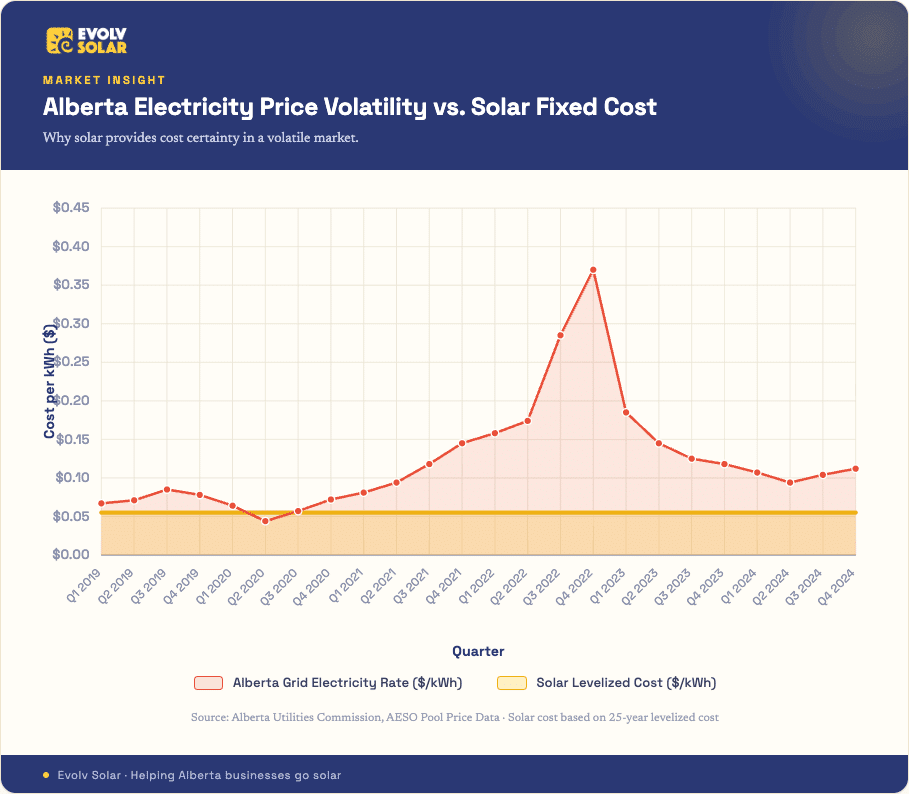
Electricity is one of the few operating expenses that businesses have limited control over. Rates can be influenced by natural gas prices, grid constraints, government policy, transmission costs, and broader market demand. In Alberta, that volatility has been very real, with floating electricity rates reaching $0.37/kWh in December 2022. Many businesses were caught unawares and were heavily impacted when their utility cost basis increased dramatically.
Solar helps reduce that exposure by allowing your business to generate a portion or all of its electricity on-site. Rather than relying entirely on the market, you are locking in a meaningful share of your energy costs for 25+ years. If electricity prices rise, the value of the energy your system produces rises with them.
A new source of pressure is also emerging: data centres. Driven by AI and cloud computing, these facilities are creating significant new demand for electricity across North America. As of late 2025, the Alberta Electric System Operator (AESO) had reported more than 20,000 MW of data centre connection requests, compared to Alberta’s current peak demand of roughly 12,000 MW.
The grid can only absorb a fraction of that demand in the near term without major new generation and transmission investment. While not every proposed project will proceed, the scale of interest highlights another major variable businesses cannot control. Analysts and policymakers have already flagged the risk that this surge in demand could put upward pressure on electricity costs for other users on the system, including businesses.
For companies with long-term facility plans, solar provides a practical hedge against that uncertainty. It turns an unpredictable operating expense into a more stable, predictable cost structure, while creating an asset that can pay for itself over time and continue delivering savings for decades.
The graph below showcases the electricity price volatility in Alberta from 2019 to 2024.
Is Solar right for your operation?
When evaluating a solar project, the best place to start is understanding where it can create the most value. Solar and/or solar with battery storage tends to make the strongest business case for organizations that:
• Own their building, or have a long-term lease with landlord cooperation
• Have suitable roof space in good condition, parking areas, or adjacent land available
• Consume a meaningful amount of electricity
• Have energy costs that materially affect operating margins
• Face demand charges as a significant portion of their utility bill
• Have sustainability goals, ESG reporting requirements, or customer-driven emissions targets
• Want more predictable operating costs for long-term planning
• Are structured to benefit from available tax credits or incentives
• Value energy independence, resilience, and long-term control over power costs
This list is not exhaustive, but it covers many of the key factors that make solar worth exploring. The more of these that apply to your operation, the stronger the potential business case – and the more likely a feasibility study is worth your time.
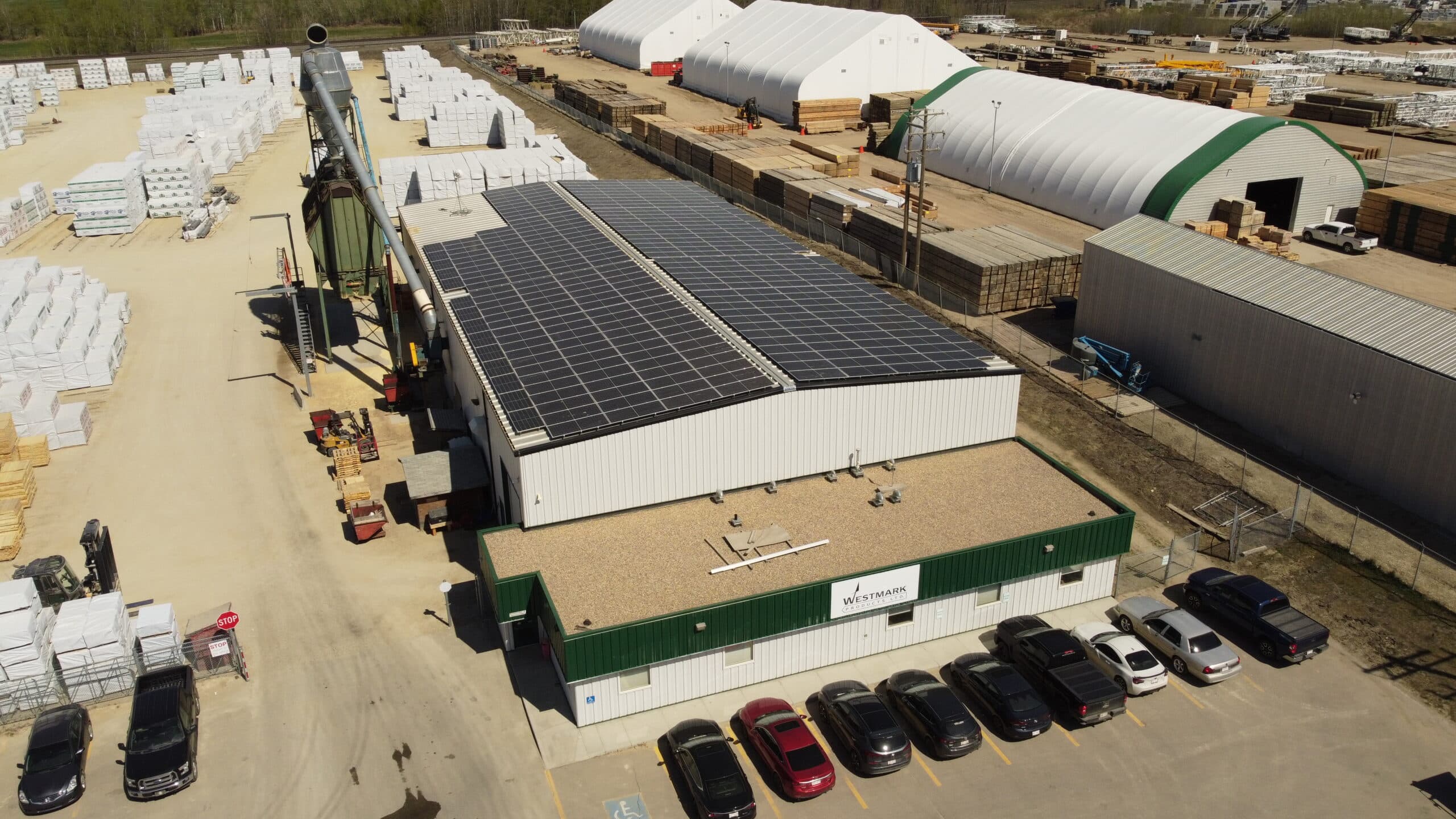
Another important lens is your operating cost structure. For most businesses, electricity is a recurring expense that can rise over time and is difficult to control. Solar changes the nature of that line item by converting a portion or all of your energy costs from a volatile operating expense into a more predictable, long-term asset.
Where electricity represents a meaningful share of overhead, that stability can directly support operating margins, budgeting, and long-range forecasting. We cover the full financial picture, including incentives, payback, depreciation, and accounting considerations, in Parts 3 and 5.
Benefits of commercial solar beyond the Bill
The financial returns for direct cost savings on energy are compelling, but understanding additional benefits will help you in your evaluation:
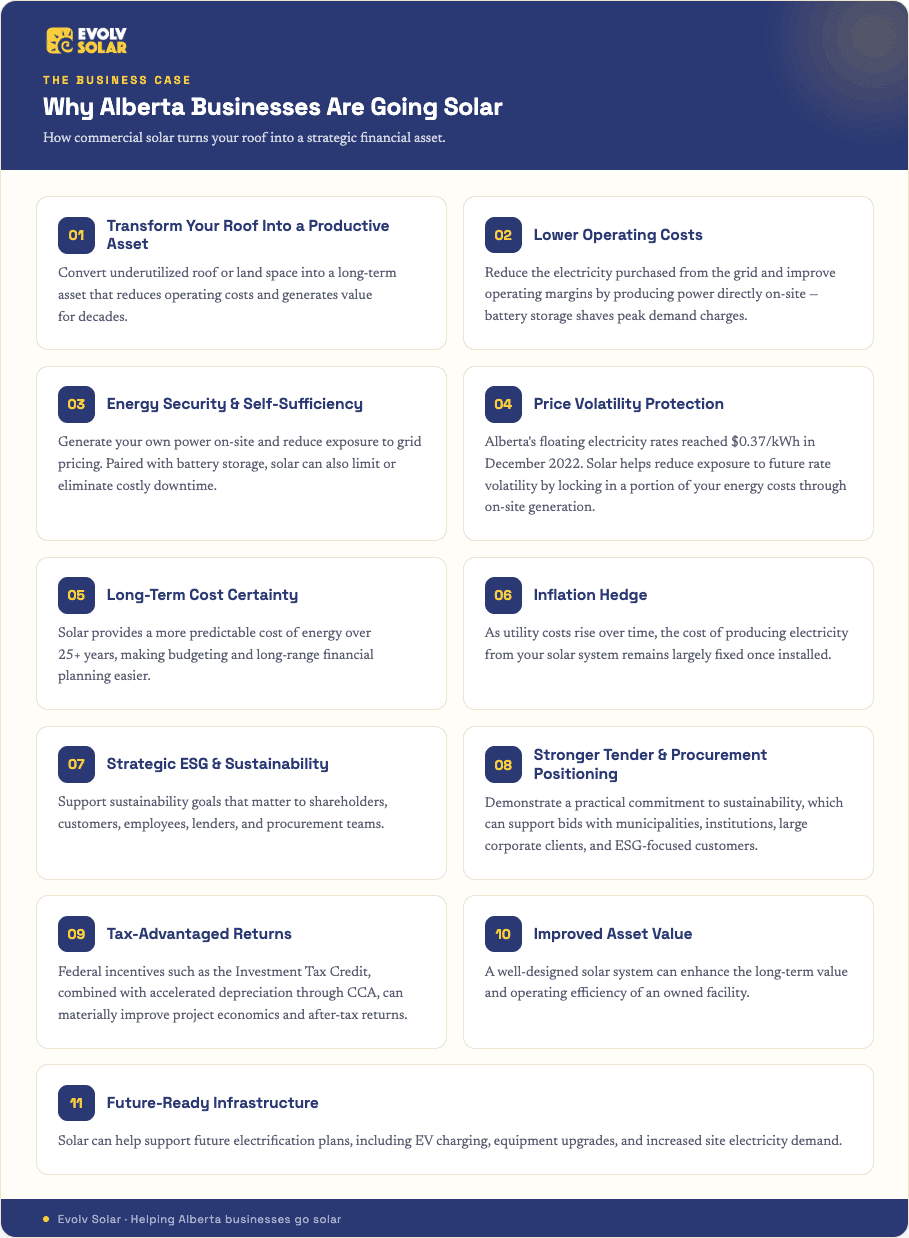
While there are many reasons our commercial and industrial clients choose to install solar, the above are the most common we see in feasibility discussions with business clients in Alberta.
Does Solar Actually Work Well in Alberta?
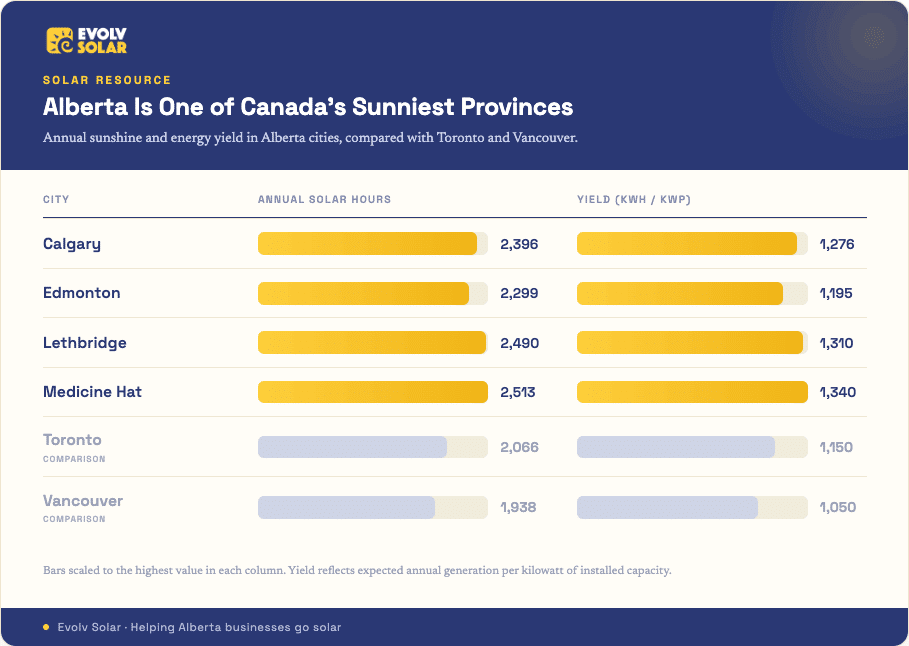
As the sunniest province in Canada with an average of over 312 days of sunshine per year, Alberta offers some of the strongest fundamentals for commercial, agricultural, and industrial solar investment for businesses across Canada. In addition to the number of sunny days, Alberta also offers one of the only deregulated electricity markets in Canada with a solar-friendly retail environment. The chart below depicts the average solar yield per installed kW in major Alberta cities versus Toronto and Vancouver.
What about solar production in the winter months?
It’s one of the first questions almost every Alberta business owner asks: does solar really work in winter?
The answer is yes—and often better than people expect. Solar panels generate electricity from sunlight, not heat. In fact, panels typically operate more efficiently in colder temperatures than they do in extreme summer heat. On a bright, clear Alberta winter day, a solar system can still produce meaningful power.
Snow and shorter days do reduce winter production, but they do not undermine the annual business case. Commercial arrays are typically installed at an angle, which helps snow shed more easily. Snow on the ground can also reflect additional light onto the panels, supporting production during clear conditions. While December and January naturally produce less energy than the long, sunny months from spring through fall, those seasonal variations are already built into solar production modelling.
For Alberta businesses, the key is looking at annual performance rather than judging the system by its lowest-production months. A well-designed system generates surplus power during stronger production periods, helping offset grid consumption during lower-production winter months through Alberta’s micro-generation framework.
In short, winter does not break the solar business case. It is already accounted for in the numbers.
See an industrial installation in action
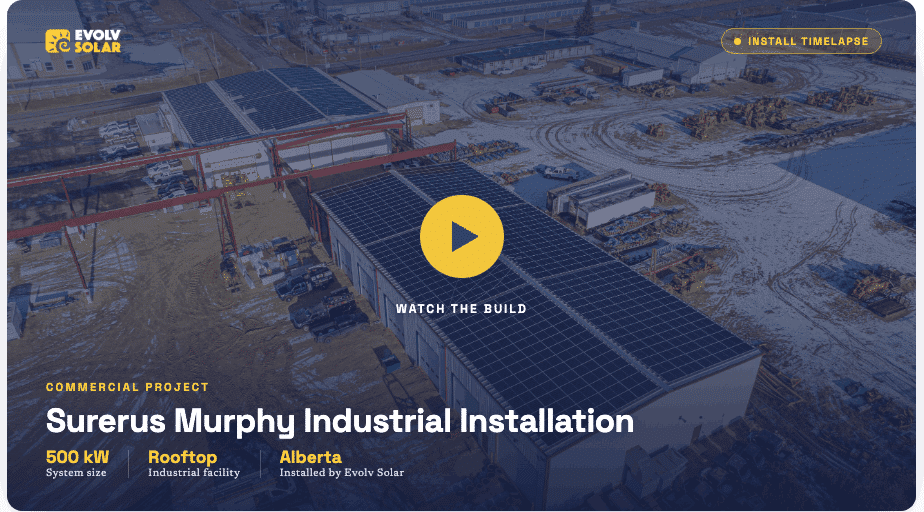
Want to see what a commercial solar installation looks like from start to finish? Watch our video of a commercial installation in Spruce Grove AB by clicking on the image below:
Now that you understand whether solar might be right for your business, the next question is: what’s it actually going to cost, and what incentives are available?
In our next post, we’ll dive deep into the financial incentives that make commercial solar in Alberta so compelling:
The Federal Clean Technology Investment Tax Credit (ITC): How to capture 20–30% of your system cost as a refundable tax credit
Accelerated Capital Cost Allowance (CCA): 55% first-year depreciation and why the order of operations matters
Alberta’s Micro-Generation Regulation: The critical 150 kW AC threshold that could make or break your ROI
Solar Club Rates: How to earn up to $0.35/kWh for your exported power
Carbon Credits: An additional revenue stream worth $80,000–100,000+ over 10 years for a 100 kW system
These incentive programs are what transform commercial solar from a “nice to have” into one of the strongest investment opportunities available to Alberta businesses today.
[Read Part 2: Solar Incentives & Revenue Streams in Alberta→]

Written by Garrett Hay, Commercial Development Manager at EVOLVsolar – [email protected]
EVOLVsolar is Western Canada’s leading solar company with over 2000 projects and multiple highly experienced installation teams. We have one mission: to make solar energy affordable while giving back to the environment. By investing in solar power, you can save money on energy bills, upgrade the value of your property and reduce your energy output. You can expect high-quality solar panel installation, world-class workmanship, excellent customer service and the best solar technology available.
See our commercial and industrial solar portfolio here.
Experience the EVOLVsolar difference by contacting our corporate office today at (403) 879-1379 or via email at [email protected].
Frequently Asked Questions about commercial solar in alberta (FAQ)
Is commercial solar worth it for Alberta businesses?
For most, yes. Alberta combines some of Canada’s highest solar yields with a deregulated electricity market and strong federal incentives, so a well-sited commercial system typically pays back in about 4-8 years and then produces low-cost power for decades. It makes the most sense if you own your building, use a significant amount of electricity, and plan to stay long-term.
How much does a commercial solar system cost in Alberta?
Installed costs commonly range from about $1.40 to $2.00 per watt, depending on system size, roof type, and site complexity—larger systems cost less per watt. As a rough example, a 100 kW system often lands between $130,000 and $200,000 before incentives. We cover pricing and financing in detail in Parts 2 and 5.
What is the payback period for commercial solar in Alberta?
Most commercial projects in Alberta see a simple payback of roughly 4–8 years after incentives, and faster on high-consumption sites with strong sun and good roof conditions. After payback, the system keeps generating largely free electricity for the remainder of its 25–30+ year life.
What incentives are available for commercial solar in Alberta?
The headline incentive is the federal Clean Technology Investment Tax Credit (ITC), a refundable credit of up to 30% of eligible system costs. Businesses can also use accelerated depreciation (CCA Classes 43.1/43.2), Alberta’s micro-generation framework and export credits including Solar Club rates, and carbon credits. We break each of these down in Part 2.
Do solar panels work in Alberta winters?
Yes. Panels generate electricity from light, not heat, and actually run more efficiently in cold temperatures, so clear winter days can be productive. Output is lower in December and January because the days are short, but tilted commercial arrays shed snow quickly, and the annual yield figures already account for the full seasonal cycle.
What is Alberta’s 150 kW micro-generation threshold?
Alberta’s Micro-Generation Regulation splits systems into small-scale (under 150 kW AC) and large-scale (150 kW to 5 MW AC), each with different rules and connection processes. That 150 kW line is a key design decision that can meaningfully affect approvals and ROI, which is why right-sizing the system matters. We dig into this in Part 2.
How long do commercial solar panels last?
Most commercial solar systems are built to operate for 25 to 30+ years, and panels typically carry performance warranties of around 25 years+. They keep producing well beyond the payback point, with only a modest decline in output over time.